آموزش رایگان
The History of Ptolemaic and Non-Ptolemaic Astronomy in Islamic Civilization - پژوهشکده تاریخ علم utihs
The History of Ptolemaic and Non-Ptolemaic Astronomy in Islamic Civilization
28 05 2025 17:32
کد خبر : 90752434
تعداد بازدید : 13576
Introducing the Free Educational Course "History of Astronomy in Iran During the Islamic Era" on Maktabkhooneh
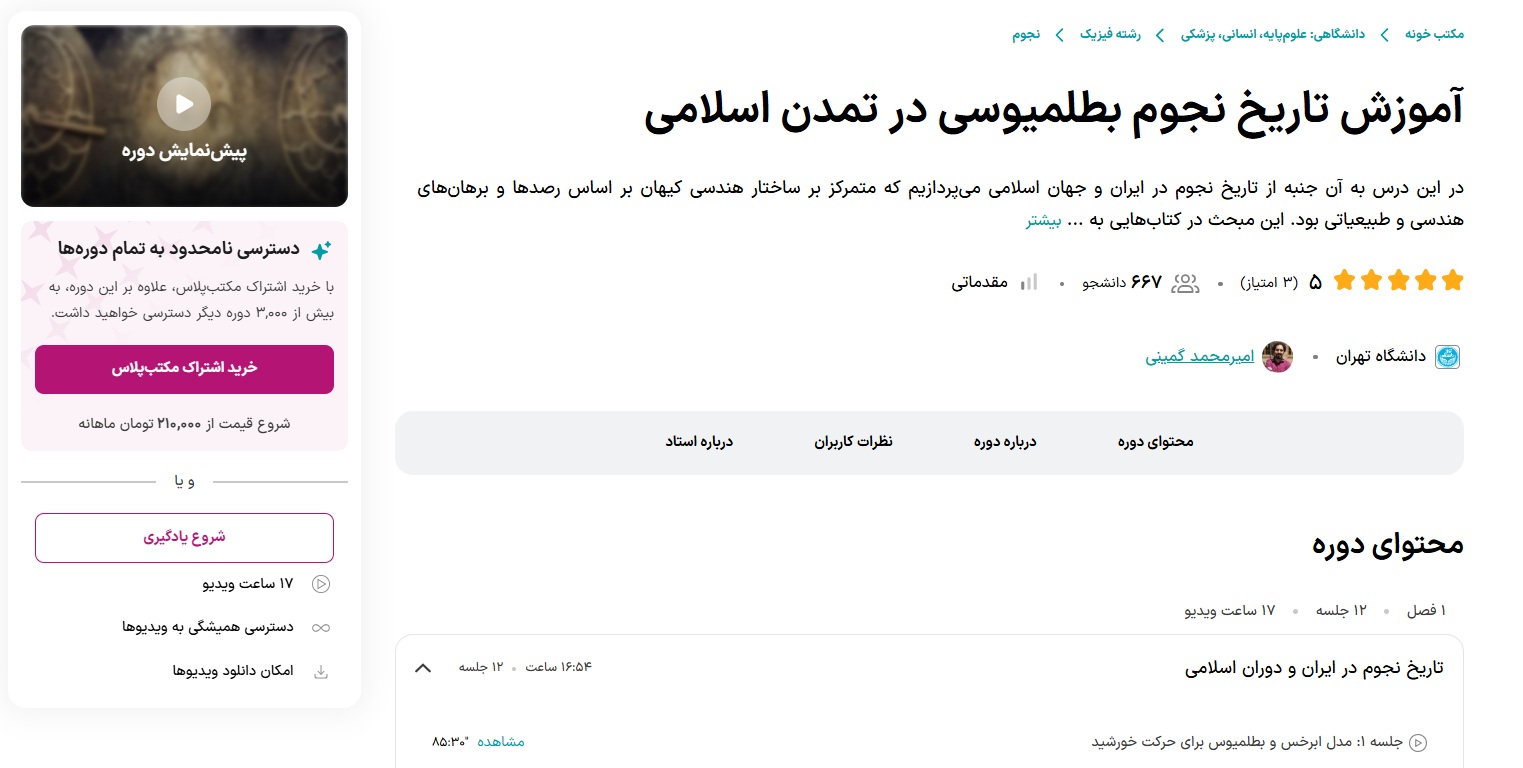
The Institute for the History of Science at the University of Tehran, in collaboration with the Maktabkhooneh educational platform, offers the free educational course "History of Astronomy in Iran During the Islamic Era" to those interested in the history of science and astronomy. This course, taught by Dr. Amir Mohammad Gamini, a faculty member of the Institute for the History of Science at the University of Tehran, explores the historical and scientific aspects of astronomy in Iran and the Islamic world, with a focus on the geometric structure of the cosmos.
How to Access
This course is available for free on the Maktabkhooneh platform, and interested individuals can register through the following link:
History of Ptolemaic and Non-Ptolemaic Astronomy in Islamic Civilization
Course Content
The course is designed in 12 sessions and covers key topics such as Ptolemaic models, innovations by Islamic scholars in refining these models, and astronomical works in Islamic civilization. Some of the topics discussed in the course include:
- Session 1: The models of Hipparchus and Ptolemy for the motion of the Sun
- Session 6: The observational origin of the equant point in the model of outer planets
- Session 9: Introduction to astronomical works in Islamic civilization and their characteristics
The course particularly focuses on the geometric models of celestial spheres and the motion of planets based on observations and geometric and physical proofs, which are known as "astronomical works" in the scientific texts of Islamic civilization.
Target Audience
This course is suitable for individuals familiar with Euclidean geometry at a high school level. Additionally, familiarity with observational astronomy and planetary motion can enhance understanding of the content, although necessary explanations are provided during the course. This course will be highly beneficial for students of the history of science, researchers in the history of astronomy, and those interested in the history of Islamic civilization.
The Institute for the History of Science at the University of Tehran invites all interested individuals to participate in this course and take a step toward a deeper understanding of the history of science in Islamic civilization.
Tags
Share


Short Link
https://utihs.ut.ac.ir/en/article/90752434